The family and every connected physician see the same picture.
For patients and families. For physicians: what Mēdota does inside the consultation. The model is built so the Krankenkasse funds it and the practice never pays.
Each practice keeps its own records. The family carries the whole picture, again for every new doctor.
One diagnosis, then several practices.
It starts at the general practice. Then come a specialist, a clinic and a second specialist. Each keeps its own records, and none of them sees the others’.
The family becomes the courier.
Results, doctors’ letters and medication plans rarely travel digitally, and the discharge letter goes home with the family. The paper piles up at home, and each practice sees only what reaches it. Not everything does.
Then a new doctor asks for everything.
It might be a second opinion, a new specialist or a specialist centre abroad. The family writes to every hospital again, and each hospital’s records office finds, copies and sends what it holds. Some of it never arrives.
And research runs alongside, unwatched.
New papers appear every day, and clinical trials look for participants. Nobody is watching them for this patient, so what matters can be missed.
One view in the middle.
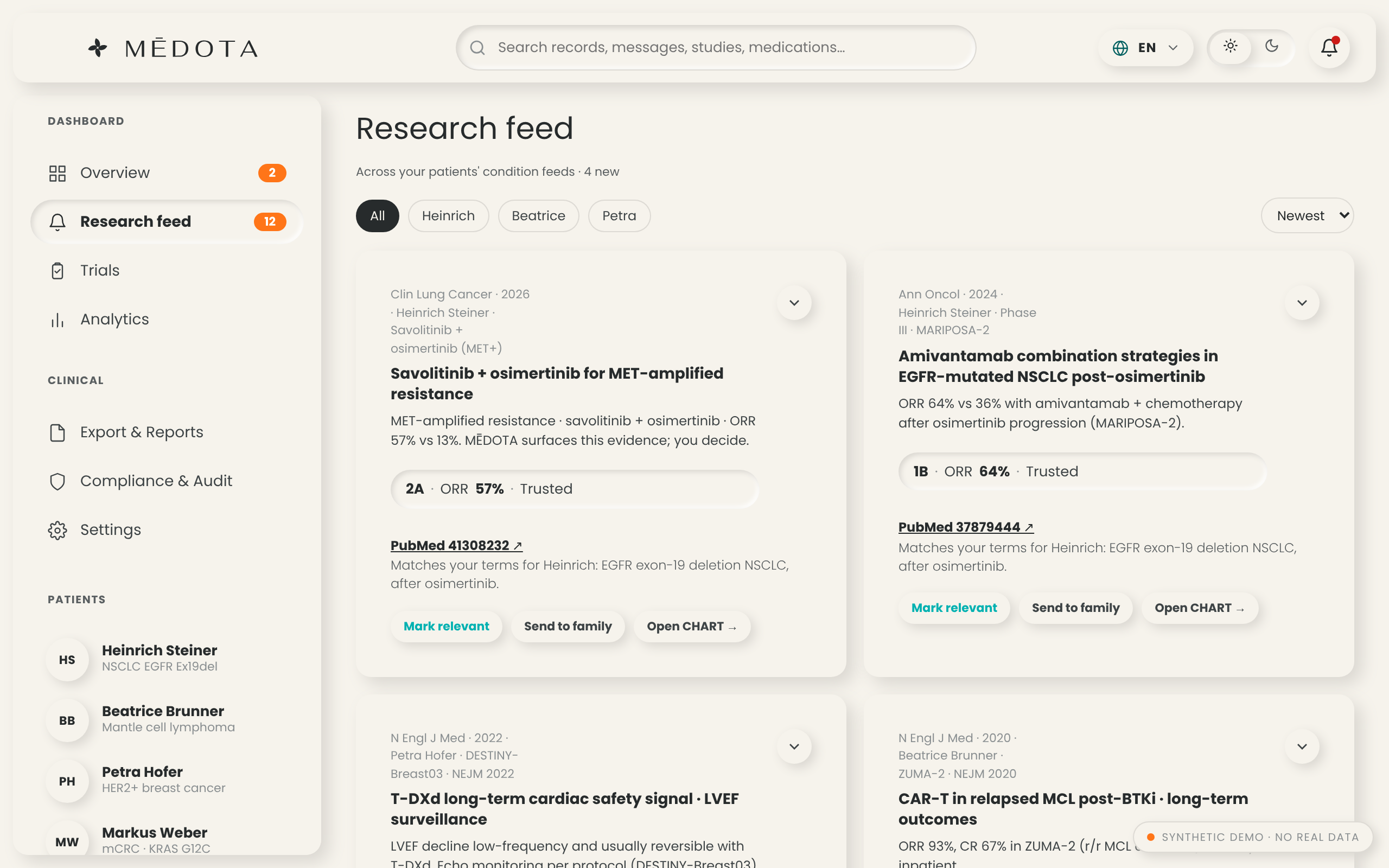
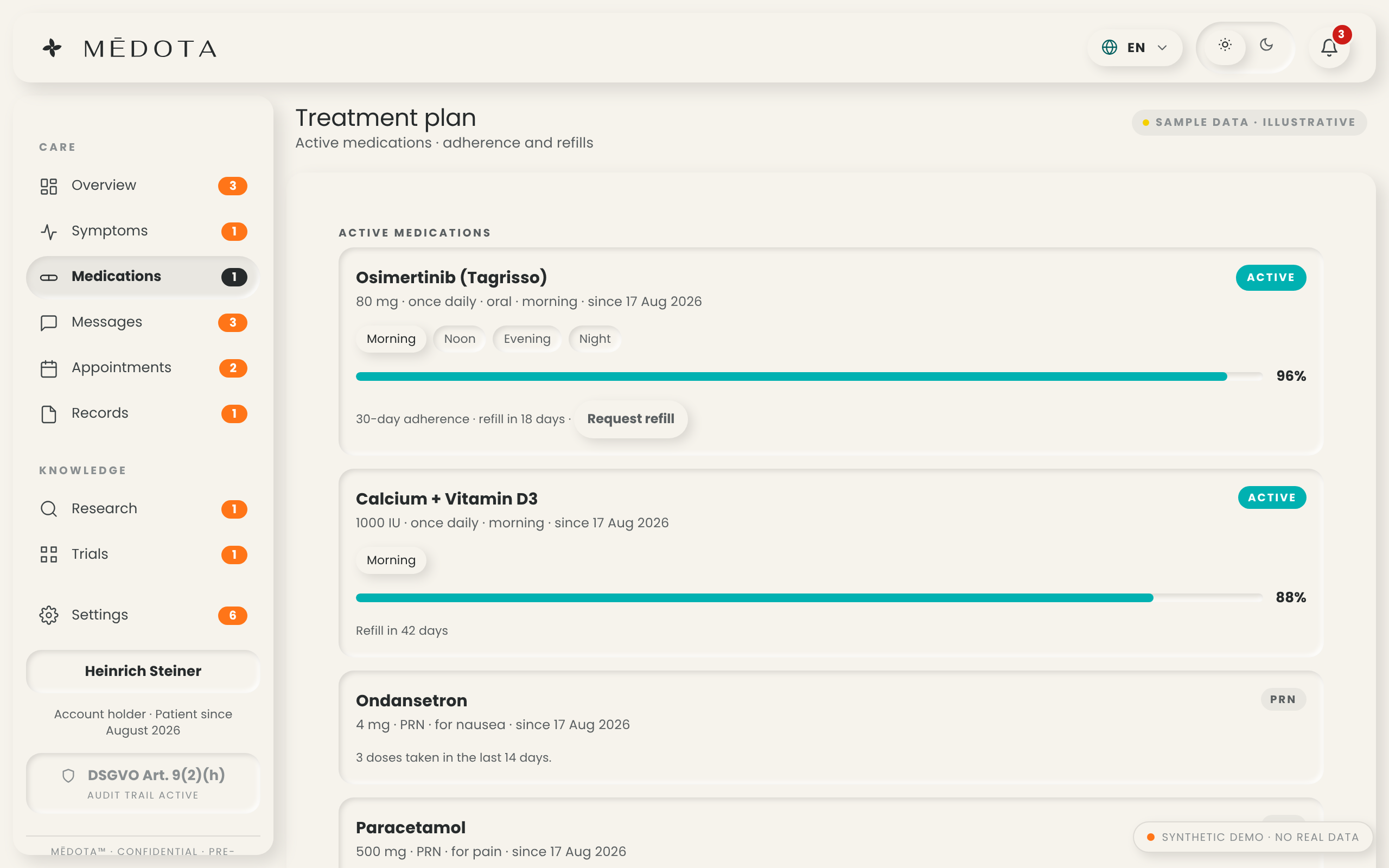
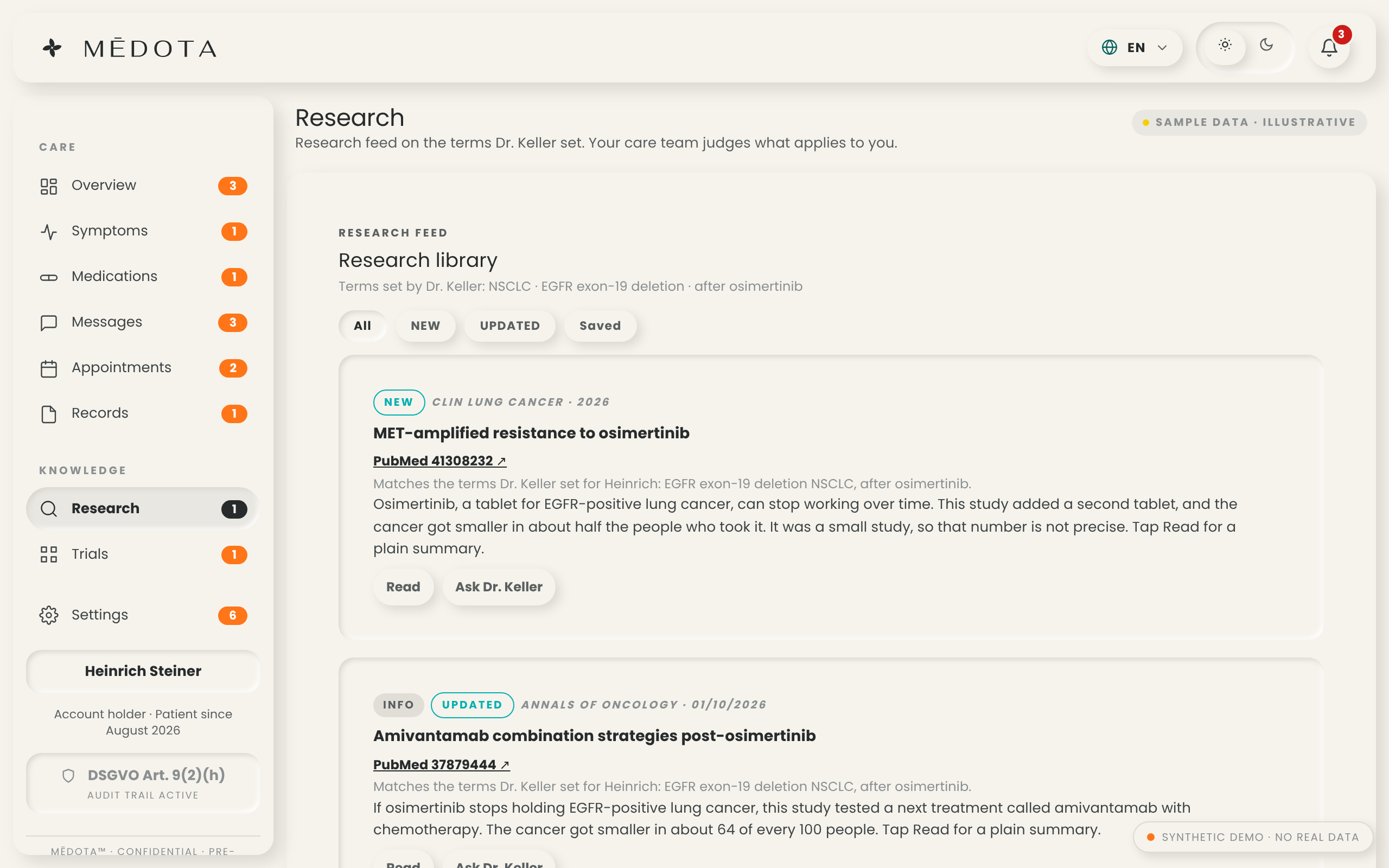
Mēdota sits in this gap. It watches the sources on the terms the physician sets, and brings research, trials and what each practice shares into one view. Every connected practice and the family see the same picture.
Two readers.
The practice reads in clinical detail: the visit prepared, the documentation prepared. The family reads in plain language: research, trials, questions for the visit. The decision stays with the physician.
The Krankenkasse funds it without seeing an individual case.
Your health record (in Germany, the ePA) stays as it is. Free for the practice. The model is built this way.
Built by someone who lived through the gap twice.
“My son has a rare disease, and my father has Alzheimer’s. We live in Germany, and my father lives in Sweden. Still, none of their doctors in either country have ever mentioned a study or a trial to us. I don’t blame them, since doctors don’t have the time to keep up with everything that’s published. So the family ends up doing the legwork. Every new doctor needs the full history, so you spend your time chasing down letters, test results, and X-rays from every clinic and hospital, plus getting new referrals for each specialist. Sometimes, things never arrive. You do all this while you’re sick yourself or caring for someone who is, often working less or not at all, and with less money coming in.That’s why I created Mēdota - for myself, my son, my father, and my mother. With Mēdota, the whole family and every connected doctor can see the same information, and the platform keeps track of research and trials for each patient. I realized it could help millions of families and their doctors, so I committed fully to it. Doctors still make the decisions, and I designed Mēdota so that the Krankenkasse can cover it without ever seeing personal cases. I don’t want any family to feel alone or overwhelmed, or any doctor to discover too late that the answer was already available.”Mattias Aybar, Founder
Every avoidable visit costs a family a day it does not have and a physician an hour that never comes back. Every European public payer sees the same pattern.
- The family avoids the slow drain.
- The physician gets the time back.
- The Krankenkasse gets something it can measure, not a promise.
Patients look to their doctors for new trials. In practice, there’s often no time to search.
Impossible to read, and not all of it can be trusted. A 2026 screen flagged about 250,000 of 2.6 million cancer papers as possibly paper-mill-linked.
Source · Elsevier, Embase content page; QUT paper-mill screen (BMJ, 2026); Civey for BPI and vfa (2024)
Europeans with a rare disease, cancer or life after it, an autoimmune or chronic condition, or Alzheimer's. A floor, never a sum.
average diagnostic odyssey for rare disease patients in Europe.
of clinical trials miss their original enrolment timelines.
One product in two versions. The law decides which part reaches patients first.
Research and trials updated daily from PubMed, ClinicalTrials.gov, EMA, FDA and preprints. End-to-end encrypted for patient data.
Built for patients and physicians.
Plain language for patients. Clinical detail for physicians. German and English today; more languages to follow.
Used first.
The shared view, the research and trial feeds the physician sets up, the documentation, and the messages between the family and each doctor. Mēdota surfaces; the physician decides. On our reading it needs no CE certificate, which we confirm in writing before the first German care contract uses it.
After certification.
It adds matching studies to one patient, ranking what matters most and spotting patterns in symptoms. No patient sees it until CE Class IIa certification.
Built for EU health-data law and for Krankenkasse review. The ePA stays as it is.
Designed for operation with patient data: BSI C5-aligned, EU-sovereign-hosted, end-to-end encrypted, with a record of the physician’s duty to inform and of its documentation. In Germany those duties are § 630e BGB and § 630f BGB. Mēdota supports the physician in meeting them; the duty and the decision remain the physician’s. Patient data stays in the EU. Cancel and your data is permanently deleted within thirty days.
Built for every person living with a complex condition. And the physicians fighting alongside them.
More than 19 million people in Germany. More than 60 million across the EU. Both figures are floors, never sums. A rare disease, a cancer trajectory including life after cancer, an autoimmune or complex chronic condition, and Alzheimer’s and neurodegenerative care. Every one of them generating research no single clinician can track unaided.
Sources · BMG · RKI Zentrum für Krebsregisterdaten · Zi Versorgungsatlas 24/05, Akmatov et al. 2025 · Deutsche Alzheimer Gesellschaft (2023) · European Commission DG SANTE · EUROCARE-6, De Angelis et al., Lancet Oncol 2024 · Alzheimer Europe (2025) · Eurostat (1 January 2026)
Partner with your care team. Don’t chase it.
Instead of carrying every letter from practice to practice, you see what your connected practices share in one view, with the research and clinical trials that fit your diagnosis, in plain language. You come to each appointment with the right questions.
- Plain-language summaries you can actually read.
- Trial visibility based on your diagnosis. Eligibility stays with your doctor.
- Exportable, shareable reports, revocable at any time.
The whole picture before the visit. The decision stays yours.
Research and clinical trials on the search terms you set, what other connected practices share, and the family’s questions, prepared before each visit. Mēdota surfaces; you decide.
For the practice team: what the family and other practices send arrives in that same view, ready before the visit. The § 630e BGB information duty and the § 630f BGB record are prepared as you work; coding stays with the practice.
- What Mēdota asks of you: set your search terms once, then read what arrives before the visit. No onboarding, nothing to learn.
- When Mēdota is wrong: every item opens its source in one click and says why it matched this patient. Mēdota surfaces and never recommends, so a wrong item costs you one click, not a decision.
- Who carries the rest: in the pilot, Mēdota sets up with each physician and stays with the practice. It passes only if your visit preparation (the anamnesis and the § 630e / § 630f record) takes half the time after the first twelve weeks.
It started with one family. Now it is built for millions. And the physicians fighting alongside them.
Mēdota began as a way to lift the weight off patients and families living with complex conditions. It became a tool patients and physicians use together. Used well, it gives German healthcare back its scarcest resource: a clinician’s time.
It is in development now, ahead of its first clinical pilot, built on the judgement of the patients, families, and physicians who will use it.
- Built first to relieve the stress on patients and families.
- Used by patient and physician together, in one view.
- What the pilot measures: the physician’s preparation time and how the family and each doctor communicate.
- Free for physicians, by design.